
20/10/2026 06:34
Should Your Bow-Tying Clip Become a TikTok Sticker? A Workflow for Cambodian Gift Shops

A ribbon tightening into a neat bow can make a satisfying short video. Reduced to a chat sticker, however, that same movement communicates something different: celebration, thanks or simply a pretty gift. For Cambodian gift-wrapping businesses, the useful question is whether that small visual helps a conversation without creating confusion about what the shop offers. This workflow explains how to choose a suitable clip, review its reuse settings, test its meaning and handle responses. It also gives SMM-panel customers a practical stopping point: establish what the content can communicate before considering any promotion expense.
1. Give the sticker one modest job
Start with a communication task rather than a reach target. A gift shop might want a friendly visual for thanking someone after answering a question. It might want a recognizable bow that complements its wrapping demonstrations. Those are reasonable creative purposes. Confirming a price, accepting a customization request or promising a collection time requires explicit information that a decorative image cannot reliably carry.
Consider a hypothetical Phnom Penh wrapping shop preparing a short clip of a plain kraft box with a terracotta bow. Its intended sticker means a warm thank-you. Staff agree that it will never mean payment received or order completed. This simple agreement prevents different employees from assigning different meanings to the same image. Write that purpose in the content brief before filming, and keep the full demonstration available for people who need to understand the actual wrapping service.
2. Understand the format before designing for it
TikTok describes video stickers as videos converted into stickers for direct messaging. Its guidance says creators must be at least 16 to create them or let others create them from their videos. For your own eligible video, open More options, choose Create sticker, edit, continue and review Make public before creating it. The creation option appears only when sticker permission is enabled. See TikTok’s official [sticker guidance](https://support.tiktok.com/en/using-tiktok/messaging-and-notifications/tiktok-stickers).
Treat this format as a small expressive asset. A full demonstration can explain paper thickness, box shape and finishing technique; a tiny bow usually cannot. Build the design around one recognizable movement with a clear beginning and finish. If the concept only makes sense after reading a long caption, it is a poor candidate. Keep the explanation in the original content and choose a simpler visual for the conversation.
3. Film a sample that can stand apart from its original context
Use a demonstration box prepared specifically for filming. Remove recipient names, delivery labels, personal messages and distinctive customer photographs from the work surface. A shop may have permission to show a finished order in one context without having discussed a reusable conversational image. Using an anonymous sample avoids making a customer’s celebration the raw material for a general promotional asset.
Frame the action closely enough that the ribbon remains visible at a small size. Keep the background plain, contrast the ribbon against the paper and finish with a brief steady view of the bow. Avoid a price card or seasonal deadline inside the crop. Those details can become inaccurate while the image remains attractive. In a hypothetical Siem Reap shop, a neutral sample would be more reusable than a wedding gift carrying a couple’s names, venue and ceremony date.
4. Decide whether broader reuse suits this particular post
TikTok’s reuse control links several features. Its official instructions place the account setting under Profile, Menu, Settings and privacy, Privacy, then Reuse of content. An existing video has its own control under More options and Privacy settings. Changing reuse permission can also affect Duet, Stitch and additions to other people’s Stories. Review those consequences together rather than treating sticker permission as isolated. See [TikTok’s reuse instructions](https://support.tiktok.com/en/account-and-privacy/account-privacy-settings/stitch).
Make the decision around the footage. A generic bow demonstration may be comfortable material for wider creative reuse. A commissioned design, identifiable employee performance or customer celebration may need a different decision. Ask the person responsible for the content whether they are comfortable with it appearing in other contexts. If the answer is uncertain, prepare a simpler sample. More permissive settings are not automatically better marketing, and the team should be able to explain its choice without referring to hoped-for popularity.
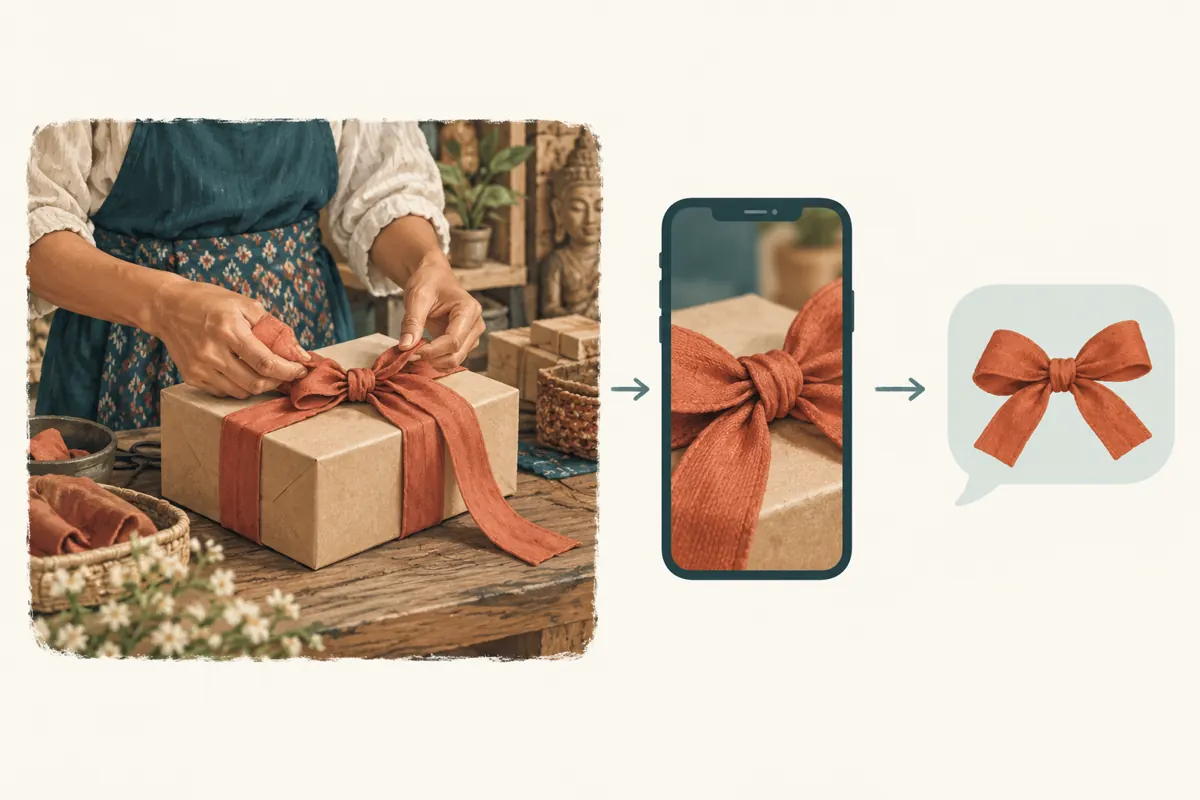
5. Test recognition and meaning with a colleague
Before using the asset in customer conversations, show it to a colleague on an ordinary phone at normal viewing distance. Do not explain it first. Ask what object they see, what feeling it conveys and whether it appears to promise anything. Then show the original demonstration. The comparison reveals whether the crop has removed an important detail or transformed a specific service example into an ambiguous symbol.
For the hypothetical Phnom Penh shop, a colleague might interpret the finished bow as ready for pickup. That is useful feedback even if the creator intended thanks. The team could choose a different moment, such as gently presenting a loose sample bow, or reserve the sticker for a written thank-you. Test again after the change. Check the first and last visible moments for awkward cropping, and make sure hands or ribbon tails do not obscure the object that viewers need to recognize.
6. Keep customer instructions in clear written messages
A friendly image can accompany a response, but the written message should carry the business facts. When someone asks about wrapping, request the item’s approximate dimensions, preferred finish, quantity and required date. Explain whether the customer needs to bring the item or provide a suitable box. Use Khmer or the language the customer understands, and confirm unfamiliar product terms rather than relying on a visual reaction.
Suppose, hypothetically, a customer sends the bow sticker back to the shop. Staff should not assume that this selects the terracotta ribbon or authorizes work. A useful reply asks whether they want that wrapping style and requests a photo or dimensions of the item. Record the eventual choice in the order conversation. This protects both sides from an avoidable mismatch: the customer may be expressing appreciation while the employee thinks a design has been approved.
7. Apply an SMM-panel relevance check before spending
The supplied catalogue includes the exact public service name “TikTok Random Comments | Arabic 🇸🇦 | Instant Start”. Its title identifies a comment-related listing, but the accompanying description is empty. There is no supporting detail establishing delivery behavior, Cambodian audience relevance or suitability for a wrapping shop. The wording is a catalogue label, not verified evidence. It does not answer the practical question of whether a bow sticker communicates clearly.
Do not buy engagement to make this experiment appear successful. TikTok prohibits services that artificially increase engagement, and it may remove inauthentic signals or take enforcement action. See its [Integrity and Authenticity guidelines](https://www.tiktok.com/community-guidelines/en/integrity-authenticity/). Purchased engagement is not evidence of genuine interest, sales, advertising delivery or Cambodian users.
For an SMM-panel customer, the sensible decision here is to decline an unrelated engagement order. Put the available effort into the sample video, understandable replies and a reliable enquiry process. Catalogue availability does not establish platform permission, official affiliation or business usefulness.

8. Review conversations without inventing attribution
Keep a small review note that distinguishes creative feedback from customer activity. Record whether colleagues understood the sticker, whether customers asked about the demonstrated finish and whether any conversation progressed to a confirmed specification. Use concise summaries without copying private messages into a general marketing document. The goal is to identify communication problems, not to build a decorative report full of unrelated totals.
If a customer explicitly says the bow demonstration helped them choose a finish, record that as their stated reason. If they merely send a sticker, record only that interaction. Do not assign a sale to the sticker because it appeared somewhere in the conversation. For the hypothetical shop, repeated questions about whether a box is included would suggest an information gap in the demonstration. Clarifying that point could be more useful than producing another variation of the same bow.
9. Avoid mistakes that make a small asset harder to maintain
A common mistake is placing too many jobs inside one image: logo, greeting, price, product sample and booking instruction. At chat size, the result becomes cluttered. Another is choosing a beautiful close-up that conceals the difference between ribbon alone and a complete wrapping package. Show the offer clearly in the source demonstration, and keep the conversational asset simple.
Avoid sending the sticker repeatedly to people who have not asked for help. Repetition can make a friendly visual feel intrusive. Also avoid interpreting every reuse as an endorsement of the business. People may enjoy the image independently of its creator or service. Finally, do not let employees improvise operational meanings. If one worker uses a bow for thanks and another uses it for finished orders, customers must guess. A short internal rule is easier to maintain than correcting inconsistent conversations later.
10. Assign an owner and a reason to review
Give one employee responsibility for the source clip, the approved purpose and the review note. Keep an original copy of the footage and record which sample materials it shows. Revisit the asset when the shop changes its wrapping offer, stops using that finish or receives feedback that the image is confusing. A review triggered by a concrete change is more useful than repeatedly checking whether the sticker looks popular.
Choose among three outcomes: keep it because its meaning remains clear, revise it because the crop or use is confusing, or retire it because it no longer fits the service. If an operational misunderstanding has occurred, correct the written conversation as well as changing future use. A visual can support a welcoming shop identity, but the dependable part of promotion remains the same: accurate demonstrations, understandable choices and staff who confirm what the customer actually wants.

Frequently asked questions
What if Create sticker is missing from the video’s options?
Check eligibility and the video’s sticker permission against TikTok’s official guidance. Do not assume an SMM service can unlock the feature. If the option remains unavailable, continue using the original demonstration and ordinary written replies; the customer workflow does not depend on having a sticker.
Should a Cambodian shop put Khmer wording inside the sticker?
Only if it remains readable and has one unambiguous meaning. A detailed Khmer instruction is better delivered as a normal message where the customer can read and answer it. Test any brief wording with a fluent reader at the actual display size, especially when the image could be mistaken for an order-status message.
Does deleting a video sticker erase it from every conversation?
TikTok says a deleted video sticker can still be accessed in existing chats. Treat retirement as a change to future practice, not a promise that every earlier use disappears. This is another reason to keep personal details and temporary offers out of the original asset.
Can the shop use a customer sending the sticker as design approval?
Ask for explicit confirmation first. Restate the selected ribbon, wrapping style, quantity and required date in words. A sticker may express enthusiasm or thanks without accepting the proposed specification. Begin work only after the shop’s normal confirmation process is complete.
How can a small team decide whether the experiment was worthwhile?
Look for clearer conversations and manageable staff effort. Did people understand the image, did staff use it consistently, and did it introduce any confusion? Keep it if it serves its modest purpose. There is no need to claim a sales increase or purchase engagement to justify a useful creative asset.
Explore the current service catalogue, create an account, or ask a specific question through support tickets.
- TikTok Help Center: TikTok stickers
- TikTok Help Center: Stitch privacy settings
- TikTok Community Guidelines: Integrity and Authenticity
Prepared with AI assistance. Illustrations explain the workflow and do not represent customer results.