
22/10/2026 12:24
Similar Channel or Suitable Partner? Telegram Discovery for Cambodian Candle-Mould Shops

A channel full of attractive candles can look like an obvious place to promote candle moulds. Yet its readers may want finished gifts, decorating ideas or photographs rather than equipment for making candles. For a Cambodian supplier, that distinction matters before spending time preparing a collaboration or money on promotion. Telegram’s Similar Channels feature can help uncover places worth researching, but the commercial decision still belongs to the shop. This guide follows a hypothetical Phnom Penh candle-mould supplier looking for a suitable craft-channel partner. It explains how to build a shortlist, check what remains unknown, agree on an honest promotion and evaluate enquiries separately from public counters or SMM-panel delivery.
1. Define the buyer before opening the recommendations
Start with a concrete buying situation. Our hypothetical supplier sells reusable candle moulds to people making small batches at home or in workshops. Its immediate objective is to receive questions about mould dimensions, available shapes and collection arrangements. Selling finished candles is a different objective and would require a different partner shortlist.
Write a brief sentence describing who the promotion should help and what that person should do next. For example: help Cambodian candle makers compare two mould shapes, then ask the shop about the appropriate size. This gives the team a practical filter. A beautiful channel can be unsuitable if its content attracts people shopping for ready-made gifts.
2. Use Similar Channels as a discovery starting point
Telegram’s official Similar Channels announcement explains that suggestions appear when joining a channel and can also be accessed through its profile. Only public channels appear, and selection is automatic, based on similarities between subscriber bases. That describes how suggestions are generated; it does not certify a channel’s audience location, purchasing intentions or suitability for a supplier.
Begin with a public craft channel that you already find relevant. Open its profile and look for Similar Channels. Review the suggested channels individually rather than treating the whole list as approved prospects. If the option is unavailable in your app, continue through public channel search or known business references; completing the research does not depend on one discovery feature.
3. Build a small shortlist with evidence attached
Create a simple research sheet containing the channel name, public link, review date, usual subject, language and advertised collaboration contact. Add links to representative posts and a short explanation of why each channel might help your intended buyer. Keep observations separate from assumptions. A Khmer caption is an observation; a mostly Cambodian buying audience remains an assumption unless supported.
Examine a manageable sample across different dates, including ordinary posts and earlier promotions where available. Look for consistent teaching, useful product explanations and a clear relationship between promotional material and the channel’s normal subject. A single excellent post may be exceptional. A repeated pattern of relevant content is a stronger reason to investigate further, although it still cannot prove sales potential.
4. Check product fit and Cambodian market relevance separately
Consider two hypothetical candidates. One publishes candle-making lessons but provides no information about where its readers are located. Another regularly discusses Cambodian gift shopping but focuses entirely on finished products. The first has plausible product relevance with an unresolved market question. The second has plausible local relevance with an unresolved buyer-intent question. Neither should pass automatically.
For each candidate, ask whether the content helps people who make candles, whether the promotion can be understood in the intended language, and whether your collection or delivery arrangements suit the audience being addressed. Request clarification through an appropriate business contact when available. Record unanswered questions as unknowns rather than filling gaps with guesses based on names, flags or subscriber totals.

5. Inspect the promotion environment
Read the surrounding posts as a prospective customer would. Frequent unrelated offers may make a careful mould explanation difficult to notice. Inconsistent product descriptions may also create confusion about who supplies an item or handles enquiries. These observations help assess presentation quality; they are not grounds for declaring that a channel’s audience is fake.
Check whether previous commercial posts identify the seller, distinguish demonstrations from included products and provide a usable next step. If the channel publishes collaboration requirements, read them before preparing material. Keep the shortlist focused on partners willing to present the actual offer accurately. A refusal to preserve essential details is a stronger reason to stop than an impressive public counter is a reason to proceed.
6. Contact only through a route that welcomes proposals
Telegram’s Spam FAQ warns against unwanted messages and says people should be contacted when they expect to hear from you. Discovering a channel does not give permission to message its subscribers or add them to your own channel. Look for an explicitly advertised advertising or partnership contact and follow the stated submission process.
A hypothetical proposal could explain that your shop supplies candle moulds, identify the lesson that makes a collaboration relevant and ask whether a clearly identified supplier demonstration would fit. Keep it specific and brief. Do not send repeated invitations after silence. If there is no welcomed contact route, leave the candidate on the research list and pursue another suitable option.
7. Agree on the placement before preparing the final asset
Once a partner welcomes the discussion, confirm the deliverable in writing: which channel will carry it, what media and caption are included, when it will appear, how long it should remain available and what happens if essential information is wrong. Ask about charges directly instead of estimating from subscriber numbers. Agree on how any paid relationship will be made clear.
Also establish who approves the final wording and where buyers should send questions. For the hypothetical supplier, the partner might explain the mould while the shop answers stock and collection enquiries. That division avoids a partner promising availability without checking. Save the agreed public destination and final draft together so a later report can identify exactly what was delivered.

8. Prepare a mould offer that cannot be mistaken for a candle sale
Show the empty mould clearly, then show a finished candle only as an example of the shape. State what the buyer receives and which photographed items are excluded. Provide verified dimensions with units, explain which measurement refers to the cavity or finished shape, and use your own product information for material and compatibility claims.
For a hypothetical ribbed design, the caption could ask interested makers to send the design name and required size. Avoid asking for a home address in a public discussion. Have a Khmer-speaking colleague check the customer-facing version if that is the audience’s working language. A technically accurate English description is not enough when readers cannot confidently distinguish the mould, sample candle and accessories.
9. Keep SMM-panel services outside the partner-selection evidence
The supplied public catalogue includes the exact service name Telegram Post Views. Its description is empty, so the available information identifies a post-view service without establishing delivery method, audience origin, account quality or commercial outcomes. Do not infer Cambodian viewers or interested candle makers from that title. It also does not describe a partner placement or official Telegram advertising service.
If the shop is evaluating an SMM panel, first state the problem it wants solved. Finding a relevant publisher, obtaining informed enquiries and increasing a displayed counter are different tasks. Purchased engagement is not evidence of genuine interest, sales, ad delivery or Cambodian users. A panel order therefore cannot validate the partner shortlist or prove that a supplier demonstration persuaded buyers.
Keep any existing panel activity in a separate log with the affected post and dates. Do not present a counter influenced by purchased activity to a partner as organic customer demand. If the actual objective is useful local enquiries, clearer product information and a suitable, agreed placement may address it more directly.
10. Review questions, delivery and orders as different outcomes
After an agreed promotion appears, first check the deliverable: correct channel, correct media, accurate caption and working contact route. Then record the questions received. Separate a request for mould dimensions from a request to buy finished candles, a stock enquiry and an actual order. These categories reveal whether the promotion reached the intended buying situation.
Telegram’s Channels FAQ says view totals are approximate, include views of forwarded copies and can count someone again after a period of time. A counter is therefore not a count of unique prospective customers. Record it, if useful, with the observation time and limitations rather than translating it into local reach or revenue.
Ask enquirers how they found the shop without making an answer compulsory. Record their stated source and leave uncertain cases unattributed. Review misunderstandings before repeating the placement. If people keep asking for finished candles, revise the opening image and offer wording. If questions concern unavailable sizes, review the product selection. Repeat only when the evidence supports a useful next test.
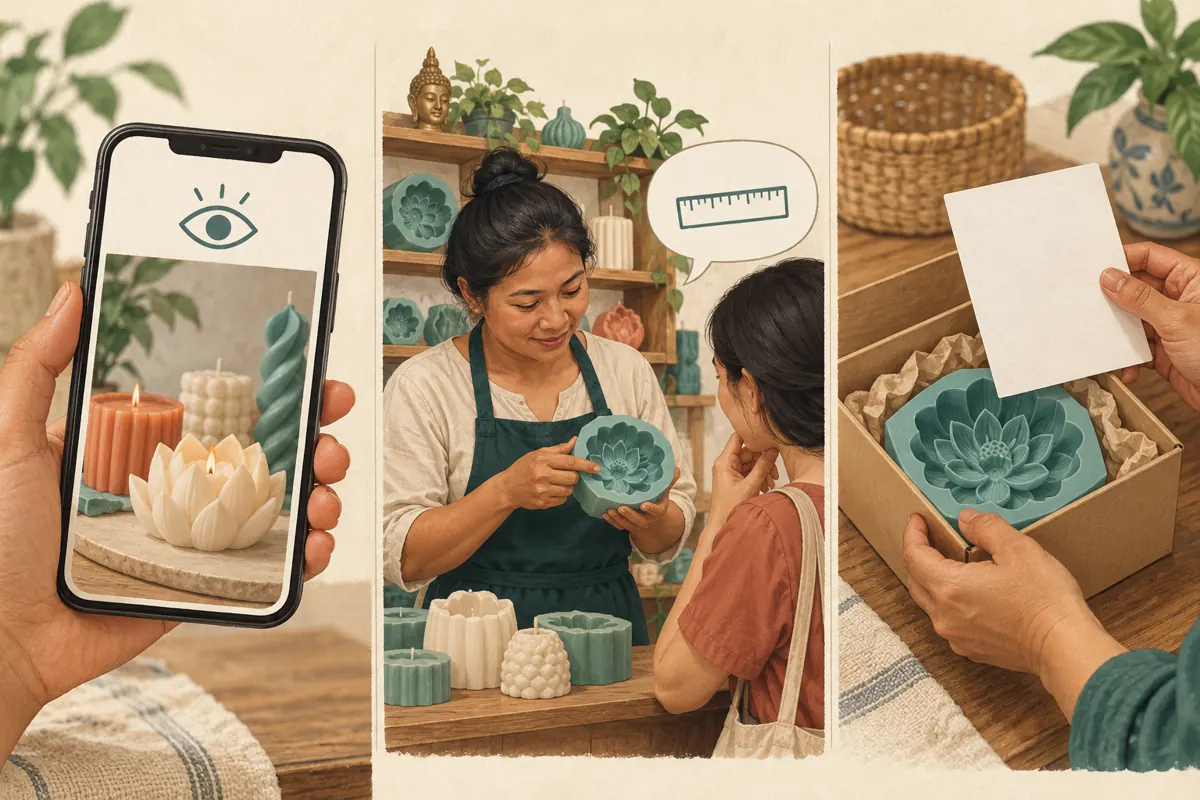
Frequently asked questions
Does appearing in Similar Channels mean Telegram recommends a business partner?
No. Telegram describes an automated channel-discovery feature based on similarities between subscriber bases. The business assessment is yours. Review the channel’s subject, presentation, collaboration process and unresolved audience questions before making an agreement. Do not describe a suggestion as Telegram’s endorsement of either the publisher or your shop.
Should a smaller relevant channel beat a larger general channel?
Neither size alone settles the decision. A channel that regularly explains candle making may provide a better setting for mould information, but its audience location and partnership terms still need checking. Compare how well each option can present the offer to plausible buyers, then weigh the actual cost and remaining uncertainty.
Can Khmer posts prove that the audience is in Cambodia?
No. Language helps assess whether your message may be understandable, but it does not establish where readers live or whether they can buy from you. Ask what audience information the publisher can support, and explain your own collection and delivery coverage clearly. Leave location unverified when the evidence is insufficient.
What if a partner promises sales based on earlier view totals?
Ask how the claimed sales were established and whether they relate to comparable products and fulfilment arrangements. Public views alone cannot answer that question. Agree on a deliverable the partner can control, such as publishing the approved demonstration, and assess your own enquiries and orders separately. Avoid making a guaranteed-sales claim part of your customer-facing promotion.
Should the shop buy post views before approaching a partner?
Purchased views do not resolve questions about product fit, audience location or buying interest. They can also make the shop’s public counter less useful as evidence in a collaboration discussion. Prepare accurate sample content and a clear proposal instead. If purchased activity already affects a post being discussed, disclose that context rather than presenting the total as organic interest.
What should happen when a placement generates questions but no orders?
Read the questions before deciding the placement failed or should be repeated. Confusion about what is included calls for clearer content; requests for unavailable designs suggest an offer mismatch. Genuine size questions may require better product guidance. Record what you learned, the work needed to respond and any confirmed orders without assuming that every enquiry will become a sale.
Explore the current service catalogue, create an account, or ask a specific question through support tickets.
- Telegram: Similar Channels, Reposting Stories, and 9 More Features
- Telegram: Channels FAQ
- Telegram: Spam FAQ
Prepared with AI assistance. Illustrations explain the workflow and do not represent customer results.